
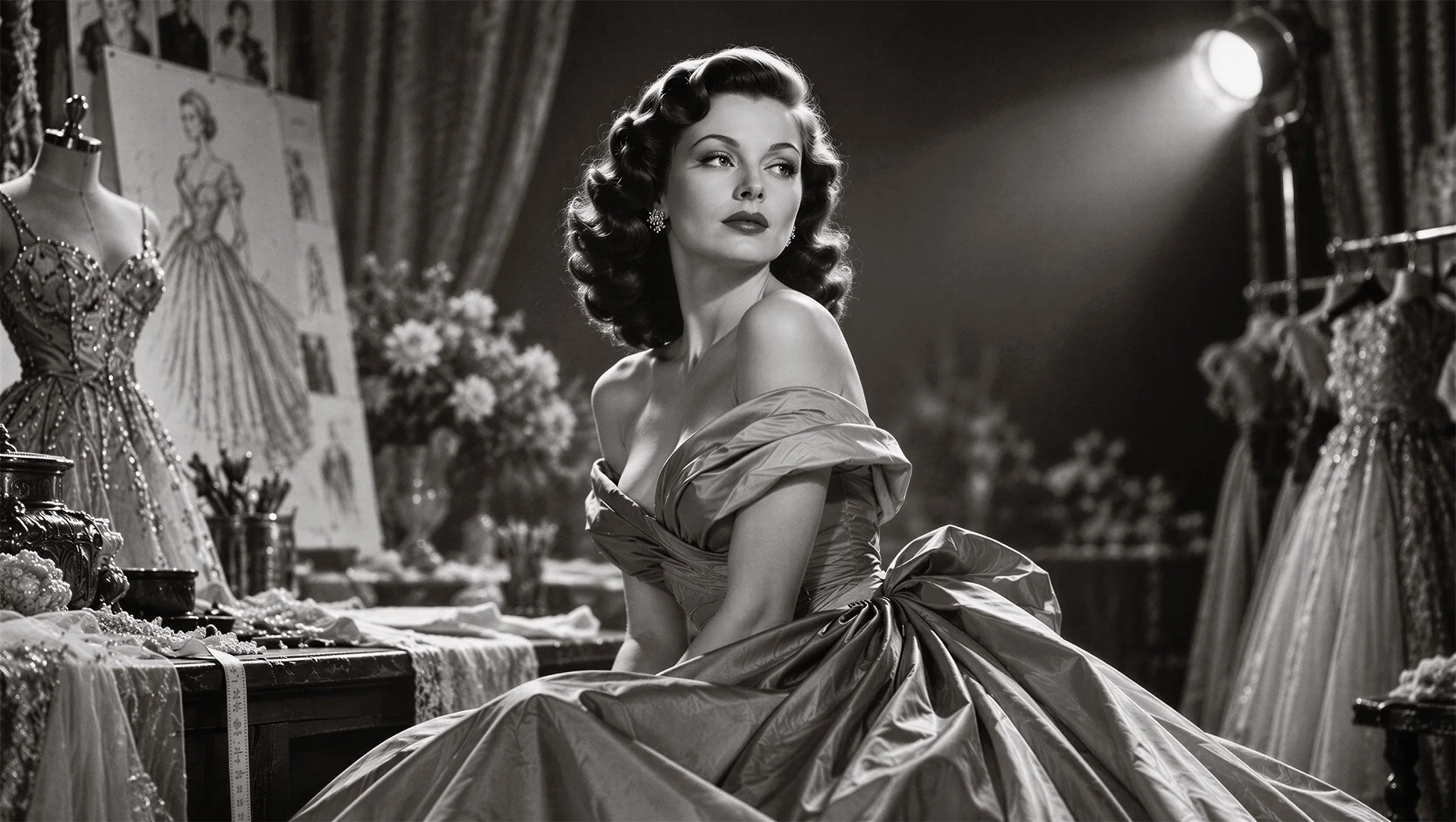
When Couture Enters the Movies
[OPENING — TRANSITION FROM SEGMENT 2]
We have just looked at how fashion photography evolved from simply recording clothing into something far more sophisticated.
By the 1940s and 1950s, photographers such as Horst, Dahl-Wolfe, Avedon and Penn were not merely documenting garments.
They were creating visual identities.
They were using silhouette, light, gesture, environment and composition to tell us who this woman was supposed to be.
And Hollywood was doing exactly the same thing. Only Hollywood had another tool available.
Movement.
The moment couture enters the motion-picture world, the dress is no longer simply photographed.
It walks.
It turns.
It catches light.
It changes shape as the actress moves.
And that creates an entirely new relationship between costume, cinematography and portrait lighting.
[SLIDE 14 — HOLLYWOOD COSTUME DESIGN]
Hollywood costume design developed into an art form of its own.
The great studio costume designers understood something very important: A costume was not merely clothing. It was a device for creating character. And it had to function under photographic light. The neckline had to work with the actress's face. The shoulders had to create the proper silhouette. The fabric had to respond properly to light.
Sequins, satin, velvet, chiffon and black fabric all behaved differently under the intense illumination of the motion-picture studio.
So costume designers and cinematographers were effectively working together—even when they weren't literally standing beside one another designing the shot.
The important element to understand in this collaboration of talents, is the production value and how important it is in today’s photography studio.
[SLIDE 15— ADRIAN]
One of the towering figures was Adrian.
If you think of the great MGM films of the 1930s and 1940s, you are looking at a world Adrian helped create.
His costumes for stars such as Joan Crawford were extraordinarily architectural.
Look at those shoulders.
They could completely redefine the shape of a woman's body.
And this becomes very important photographically.
The costume creates geometry.
The light then reveals that geometry.
A broad shoulder can produce authority.
A narrow waist can produce elegance.
A flowing skirt can create movement.
A deep neckline can place greater visual emphasis on the face.
The costume becomes part of the lighting design.
Note:
Yes — your instinct is right. It is too close to the Adrian slide.
The Adrian slide is appropriately about structure: strong shoulders, architectural silhouette, narrow waist, screen authority. The Travis Banton slide should feel noticeably more fluid and sensual. His visual language should emphasize bias-cut construction, liquid satin, long vertical drape, body-skimming line, and the way glossy fabric responds to controlled studio light.
So I would change Slide 16 in three important ways: use a much softer, more flowing pose rather than the same seated glamour pose; make the gown unmistakably bias-cut and body-following rather than architecturally structured; and make the lighting discussion specifically about specular highlight control on satin—showing how a Fresnel at an oblique angle creates long luminous gradients rather than simply “lighting the star.”
In other words:
Adrian = architecture.
Banton = fluidity.
Note:
Yes — I found confirmation that the Larrabee family portrait sequence is right at the beginning of Sabrina, roughly 2:44–3:30 into the film. A film-analysis source specifically discusses that scene and how the family members are posed for the portrait. Open Oregon
The film’s cinematography was by Charles Lang Jr., and the costume design credits include Edith Head, with Givenchy involved in Hepburn’s wardrobe. Library of Congress
For the exact frame the photographer sees, the best target is the movie itself at about 2:44–3:30. That would make a terrific teaching image because it would let us analyze the actual pose, lighting direction, tonal separation, and period portrait conventions exactly as photographed in the film.
[SLIDE 16 — TRAVIS BANTON]
At Paramount, Travis Banton Created Another Kind of Hollywood Glamour.
His work could be softer, more luxurious, sometimes more sensual. Think of the fluidity associated with actresses such as Marlene Dietrich.
Satin.
Bias-cut gowns.
Long vertical lines.
Beautifully controlled highlights.
Those fabrics become almost luminous under studio lighting. And here again, the costume and the light are inseparable. A satin gown photographed with hard frontal light can become unpleasantly reflective. Move the light sideways and suddenly the fabric reveals beautiful gradients and shape.
That is exactly the same principle we use today.
- EDITH HEAD -
And Now, We Come to Edith Head.
She understood not only fashion, but the individual actress. Her genius was often restraint.
She designed for character, body type, story and camera. And this is something photographers sometimes forget. The most successful fashion image is not necessarily the one with the most elaborate garment. It is the one in which every element belongs together.
The person.
The clothing.
The pose.
The light.
The setting.
The emotional tone.
Everything has to support the same idea.
[SLIDE 18 — HOLLYWOOD LIGHTING + COSTUME]
Now Imagine the Studio Set.
Large Fresnel lamps.
Barn doors.
Flags.
Reflectors.
Background lights.
Hair lights.
All producing continuous illumination.
The cinematographer could actually see the lighting effect before the camera rolled. And the costume designer could see how the fabric reacted. That meant the creative process could become extremely refined. A black dress could disappear into shadow unless carefully separated. A white satin gown could burn out if over-lit. Sequins could sparkle beautifully—or become distracting. A veil could become almost invisible unless struck by a backlight.
So when we study classic Hollywood images, we are really studying a collaboration between light, costume and movement.
[SLIDE 19 — GIVENCHY / AUDREY HEPBURN]
And Now Fashion and Cinema Become Even More Directly Connected.
One of the most famous relationships was between Hubert de Givenchy and Audrey Hepburn. Here the line between Paris couture and Hollywood costume becomes almost impossible to separate. Hepburn's image became associated with Givenchy's elegance.
The clean lines.
The controlled silhouettes.
The extraordinary simplicity.
And notice how beautifully that translates photographically. You do not need a complicated set. You do not need elaborate lighting. The shape itself carries enormous visual power.
This is very close to the lesson we just learned from Irving Penn. When the design is strong, simplicity becomes an advantage.
SABRINA / FUNNY FACE / BREAKFAST AT TIFFANY'S
When we look at films such as Sabrina, Funny Face, and later Breakfast at Tiffany's, Fashion is not simply wardrobe. Fashion becomes part of the storytelling.
In Funny Face, Of Course, the Relationship Between Fashion Photography and Cinema Becomes Explicit.
We see the fashion magazine world itself becoming part of the movie. We see studio photography, Location photography, Paris, Couture, Movement and Romance, And the fantasy of fashion being created before our eyes. It is almost a visual summary of everything we have been discussing.
[SLIDE 21 — FASHION PHOTOGRAPHY IN MOTION]
This is where cinema gives us another important lesson.
A still photographer freezes the gesture. A motion-picture camera watches the gesture develop. The actress walks into the light.
The skirt swings.
The fabric changes.
The head turns.
The shadow moves.
The highlight travels across the garment.
This tells us something very useful for still photography. Sometimes the best pose is not really a pose at all. It is the instant between poses. That fraction of a second when the model is moving from one position to another.
Avedon understood this beautifully.
Fashion photographers began allowing movement to become part of the photograph. And Hollywood had already been studying movement for decades.
[SLIDE 22 — CINEMATIC LIGHTING]
Now consider the difference between portrait lighting and cinematic lighting.
In a traditional portrait, we can build the entire light around one position. But an actor has to move. That means cinematic lighting often has to create a zone of illumination rather than a single perfect point. The lighting must remain believable as the actor crosses the set.
That is a much more complex problem. And yet the same fundamentals remain.
Direction.
Contrast.
Separation.
Shape.
Background control.
Everything we have been discussing still applies. It simply has to work over a larger physical space.
[SLIDE 23 — HOLLYWOOD TO VOGUE CONNECTION]
And now our title begins to make complete sense.
Hollywood to Vogue.
These were never two isolated worlds. Hollywood borrowed glamour and sophistication from fashion. Fashion photography borrowed drama and theatrical lighting from Hollywood.
Costume designers studied Paris.
Paris designers watched movie stars wearing their clothes.
Photographers studied cinematography.
Cinematographers studied portrait photographers.
It was an enormous creative conversation.
And out of that conversation came many of the visual ideas we still use today.
[SLIDE 24 — PRACTICAL LESSON FOR TODAY]
So what should we take from this as contemporary photographers?
First, do not light only the face. Also, Light the garment.
Second, do not pose only the person. Pose the silhouette.
Third, watch how the fabric reacts. Shiny fabric needs different treatment from matte fabric, and Black fabric requires separation. White fabric requires highlight control. Texture needs direction. And finally— Think cinematically.
Ask yourself: What happened one second before this photograph? What happens one second after?
If the pose feels as though it belongs to a living moment rather than a frozen mannequin, the photograph becomes much more convincing.
[CLOSING — TRANSITION TO NEXT SEGMENT]
We began with Hollywood learning how to invent the face.
Then Paris taught us how to construct the silhouette.
Now cinema has shown us how to bring that silhouette to life.
And the next step is to take all three ideas—
The face, the fashion, and the movement—and bring them back into our own studio.
Because ultimately, history only becomes useful when we can turn it into a photograph.
Studio Set and background
Main Light for Butterfly or Paramount Lighting
Fill Light
Left Edge Light
Right Edge Light
The Lighting Components