
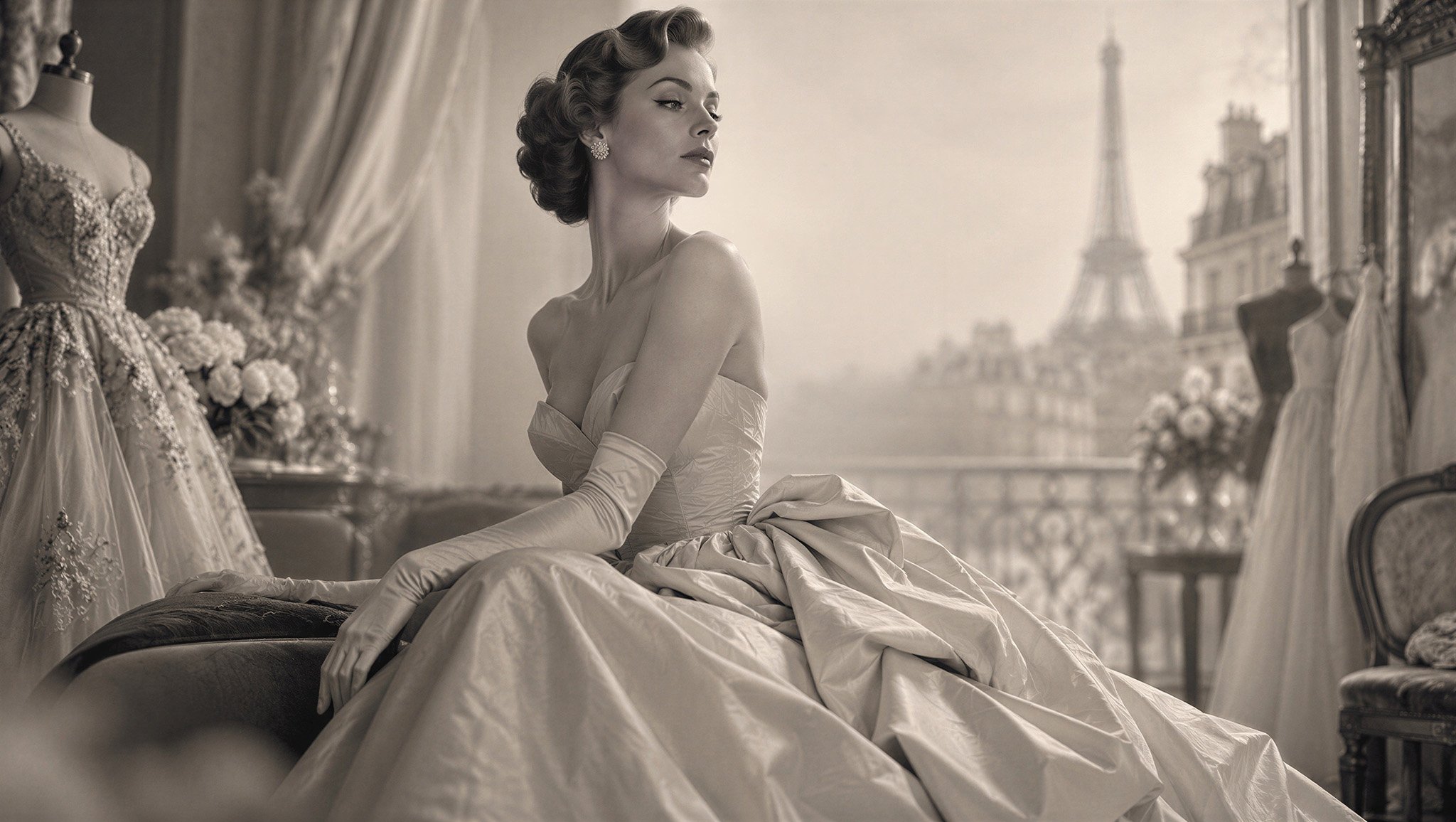
PARIS — 1947 Christian Dior changes the silhouette.
The Birth of Modern Haute Couture Photography.
Paris, Couture and the Fashion Photograph
We have just seen how Hollywood learned to create a face.
The great studio photographers of the 1930s and 1940s used light almost as a sculptor uses clay. They elevated the key light, controlled the shadows, separated the hair, illuminated the background, and retouched the negative. The objective was the star.
But across the Atlantic, another visual language was developing. In Paris, the photograph was increasingly being asked to do something different. It was no longer enough simply to make the woman beautiful. The photograph also had to make us understand :The clothes.”
And that changes everything.
Before we talk about fashion photography, we should understand what “haute couture” actually means. Today we casually use the word “couture” to describe almost anything elegant or fashionable. Historically, it meant something much more specific.
Haute Couture was clothing created individually for a client, constructed with extraordinary craftsmanship, fitted to the body, and produced by the great fashion houses of Paris. It directly translate to “High Sewing.”
This tradition, however, really begins in the nineteenth century with “Charles Frederick Worth.”
Worth did something revolutionary: rather than simply waiting for wealthy women to tell him what they wanted, he became the designer—the authority. He presented his own ideas.
In a sense, Worth helped invent not only haute couture, but the modern idea of the “Fashion Designer.”
By the early twentieth century, designers such as “Paul Poiret” began freeing women from some of the rigid structures of Victorian dress.
Then came “Coco Chanel”, whose influence was almost the opposite of theatrical excess. Chanel brought simplicity, movement, practicality and a new kind of modern elegance.
And notice what is beginning to happen. As fashion changes, the way a woman stands changes. The way she moves changes. And therefore the way she must be photographed changes.
That relationship between garment, body and camera becomes extremely important to us as photographers.
Then Europe goes through the devastation of the Second World War. Fabric is rationed. Fashion becomes restrained by necessity. And in 1947, Christian Dior does something extraordinary.
This is where posing becomes much more than simply asking a model to “stand naturally.” The pose becomes part of the design.
Dior, introduces what becomes known as the “New Look.”
Suddenly we have narrow shoulders, a tightly defined waist, and these enormous, beautifully constructed skirts. After years of wartime austerity, Dior uses yards and yards of fabric. The silhouette becomes dramatic again. And from a photographer's standpoint, look at what Dior has given us. “Shape.”
The garment itself has become architecture.
The photographer can no longer think only about the face.
We have to think about the line from the shoulder to the waist… the position of the elbows… the placement of the hands… the angle of the hips… the shape of the skirt… and the negative space surrounding the body.
This is where posing becomes much more than simply asking a model to “stand naturally.” The pose becomes part of the design.
And Dior was certainly not alone. Cristóbal Balenciaga was manipulating volume and structure in extraordinarily sophisticated ways. Pierre Balmain represented another expression of postwar Parisian elegance. Jacques Fath brought glamour and drama.
And Hubert de Givenchy developed an elegance that many of us associate immediately with Audrey Hepburn.
Then a younger generation emerges—including Yves Saint Laurent—and fashion continues evolving. But throughout this period, something important is happening for photography.
The Great Fashion Houses Need Photographs.
The magazines need photographs. And women around the world want to see Paris. And, That brings us to “Vogue” and “Harper's Bazaar.” These magazines weren't simply documenting clothing.
They were creating aspiration. They were creating a visual world in which fashion existed.
And that gave photographers an enormous creative opportunity. Intro: Cecil Beaton
Cecil Beaton could create elaborate worlds of elegance and fantasy.
Where the setting itself might become part of the fashion statement.
Horst P. Horst brought extraordinary control of form, composition and light.
Look at his photographs and you'll often see something familiar to those of us who study Hollywood portraiture. Sculpted light. Deep, intentional shadows. Elegant hands. Carefully controlled body position. But now those elements are being used not simply to photograph a celebrity.
They are Being Used to Describe “Fashion.”
Louise Dahl-Wolfe takes fashion into another direction.
She works beautifully with environment and natural light. Fashion doesn't necessarily have to exist inside an artificial studio fantasy. It can live in the world.
As Fashion evolves, Richard Avedon brings something else entirely.
Movement. Energy. Personality. His models don't always appear to be mannequins displaying clothing. They seem alive. They leap. They turn. They laugh.
The photograph captures a moment, yet the fashion remains absolutely intentional.
And then we come to the photographer who is especially important to what we're going to explore today.
Irving Penn: Penn begins stripping things away. Instead of giving us an elaborate environment, he often gives us something extraordinarily simple. A neutral background. A corner. A piece of seamless paper. A carefully placed subject. And light. That simplicity is deceptive.
Because once you remove the elaborate set, there is nowhere for a weak photograph to hide.
Every line matters. Every hand matters. Every inch of negative space matters. The position of the chin matters. The relationship between the garment and the body matters. And the light must describe all of it.
When we look at a Penn fashion photograph, I want you to notice something.
Don't look at the face first.
Look at the “Shape of the Photograph.” Trace the outside silhouette of the model with your eye. Look at what the elbows are doing. Look at the hands. Look at the relationship between the waist and the skirt. Look at the empty space between an arm and the torso.
Those spaces are not accidents. They are part of the composition.
This courtship is one of the most important ideas I want to carry into our own photography.
“Couture Posing is Architecture.”
The human body becomes the supporting structure for the garment. The garment creates another structure around the body. And the photographer organizes both structures within the frame.
Now put our Hollywood portrait beside our Penn fashion photograph.
1940’s Hollywood asks: “How beautifully can I photograph this face?”
Fashion photography asks: “How beautifully can I photograph this entire idea?”
The face is still important. But now the face is just one component. The hairstyle is another. The hands are another. The garment is another. The silhouette is another. The background is another. And light has to bring all of those elements together.
This is the bridge between the two photographic worlds we're studying. Hollywood teaches us how to “Sculpt the person with light.” Couture teaches us how to “Sculpt the entire frame.”
And when those two traditions come together, we begin arriving at the kind of portraiture that I find particularly exciting. It has the glamour of Hollywood… the discipline of fashion photography… the elegance of couture… and the control of the photographic studio.
[TRANSITION TO SEGMENT 3]