

THE GOLDEN AGE OF PORTRAIT PHOTOGRAPHY - Segment 1
Hollywood Invents the Face — The Characters of Light
“Light has character. Before we can control light, we have to learn to read what it is saying.”
“Before photographers talked about soft-boxes, TTL, LED panels or Photoshop, Hollywood had already learned something fundamental.” - Light could create the person.
It could make someone mysterious, romantic, powerful, vulnerable, dangerous—or unforgettable.The Golden Age of Hollywood was not simply a period of beautiful photographs. It was a laboratory in which photographers learned to sculpt personality with light.
Hollywood Invents the Face — The Characters of Light
The Golden Age of Portrait Lighting — 1930s–1940s
Script
Hollywood did not merely record what its stars looked like.
Hollywood invented the face.
Studios understood that the camera could create a visual identity just as deliberately as a costume designer could create a character.
The shape of the light, the direction of the shadow, the hairstyle, the makeup, the pose, the background, the lens, and finally the retouching all worked together.
The result was not simply a likeness.
It was a persona.
And this is where our study begins.
Because when we look closely at these photographs, we discover that there was never one universal formula called “Hollywood lighting.”
The lighting changed according to the person.
Script
The Hollywood star was not simply discovered. The star was constructed.
Look at the differences between these faces; Garbo is mystery, Gable is strength, Hedy Lamarr is sculptural beauty, Veronica Lake is concealment and intrigue, Rita Hayworth is sensuality and movement, Ingrid Bergman is naturalism, Jimmy Stewart is character, Susan Hayward is strength and emotional presence, Cary Grant is refinement and control.
These are not simply different people. They are different lighting intentions. That gives us the central question for Segment 1:
What is the light telling us?
And throughout this segment, we are going to answer that question in four steps:
See the shadow.
Infer the light.
Understand the intention.
Apply it today.
Script
To understand the photographs, we first have to understand the environment in which they were made.
This was a physical form of photograph; Large-format cameras, Hot Fresnel lamps, Barn doors, Flags, Cutters, Reflectors, Painted backgrounds, Hair lights, Background lights, and finally, hand retouching.
The photographer did not turn a dial on a flash trigger.
He moved the light, He spotted or flooded the Fresnel, He feathered the beam, He moved a reflector closer, He added a flag, He changed the subject’s position by inches, and there was no LCD screen afterward to rescue a mistake. The photograph had to be largely solved before the exposure was made. That created a very different kind of discipline.
Script
George Hurrell is one of the photographers who best demonstrates this discipline. When we study a Hurrell portrait, we should not begin by asking: “What light did he use?” Instead, begin with:
What evidence did the photograph leave behind?
Look at the catchlights. Look at the nose shadow. Look at the cheek. Look at how quickly the face falls into darkness. Look at the hair separation. Look at the background.
The photograph itself contains a lighting diagram—if we learn how to read it.
And this introduces one of the most important ideas in the entire presentation:
Shadow is not the absence of good lighting. Shadow is part of the composition.
Hurrell used darkness just as deliberately as illumination.
Script
Hedy Lamarr gives us a particularly clear example of light behaving almost like sculpture.
Her face already contains extraordinary structure. But notice what the lighting does. It reveals planes; Cheekbone, Jaw, Eyes, Lips, Forehead, Neck.
The light does not simply make her brighter, It defines form, this is why I think of this kind of portraiture as sculptural lighting. The photographer is not decorating the face, he is revealing its architecture.
FEATURE SECTION — HEDY LAMARR: THE STORY BEHIND THE PHOTO
Left: Eric Carpenter’s February 20, 1939 Hedy Lamarr image. A recreated 1940s studio environment and plausible lighting scenario.
Script
Now we can take this idea one step further.
On the left is the original 1939 photograph of Hedy Lamarr. On the right is my reconstruction of a possible studio environment that could produce similar visual evidence.
I am deliberately calling it a plausible reconstruction. As we do not have the original lighting diagram. But we do have the photograph, and that gives us clues.
We can study: the direction of the facial highlight, the shape of the nose shadow, the separation in the hair, the relationship between Hedy and the sculpture, and the illumination on the background.
Then we ask:
What arrangement of lights could reasonably have produced those clues?
This is exactly how I consider the best way photographers can learn to think. Not memorize recipes, but how to read photographs.
AMOS CARR: WHEN HOLLYWOOD LIGHT ENTERED THE PORTRAIT STUDIO
I would make this one of the major emotional moments of the segment.
AMOS CARR STUDIOS — HOLLYWOOD, 1953
Same Subject-Same Session-Different Stories Told With Light.
Script
In 1953, I encountered this lighting tradition personally. I was ten years old when my family took me to Amos Carr Studios in Hollywood. I remember the session clearly, it lasted roughly an hour. There were changes of clothing. A clothespin or two behind my white shirt so that it would fit properly for camera. The posing was deliberate and choreographed. The expressions were directed, and the lighting positions changed.
When the proofs came back, we received approximately twenty-five 4-by-5 contact proofs.
And what is remarkable to me now is that they were not twenty-five attempts to make the same photograph. They were twenty-five character studies. Each image seemed to ask:
Who could this young actor become?
This first portrait at the left, is open, polished, and approachable. The nose shadow remains separate from the cheek shadow. We would identify this today as a classic loop-lighting pattern. The key is directional, while the fill is carefully controlled. And look at the white shirt, it retains texture. The folds remain visible. The highlights are not empty.
At the same time, the darker hair, eyes, tie, and shadow side of the face remain fully printable.
That is not an accident. That is exposure discipline.
Now compare the second portrait on the right.
The same child, the same photographer. The same studio. But the character is completely different. The light has moved laterally. The nose shadow extends toward the cheek shadow.
The far cheek retains the characteristic illuminated triangular region associated with Rembrandt lighting. The pose is quieter. The expression is more introspective. The lighting ratio is higher. The result feels more dramatic. Same face. Different light. A different story.
THE LIGHT WAS HARD-THE RESULT WAS NOT.
Script
These photographs also challenge a common assumption. Hard light does not necessarily produce a harsh photograph. The original light may well have been Fresnel-based and strongly directional. But the photographer could control its character through: distance, feathering, spot and flood adjustment, fill, reflectors, flags, and careful exposure.
The key light created structure. The fill determined how far that structure fell into shadow. So we arrive at an important distinction:
Softness of source and softness of result are not always the same thing.
The light was hard. The result was not.
[SLIDE 8 — EXPOSURE DISCIPLINE]
Script
There is another lesson hidden in this photograph. The white shirt retains detail. That matters.
Later, after we had selected four images, the four negatives were taped together and contact printed onto an 8-by-10 comp card. As I remember it, those negatives printed cleanly together without individual dodging or burning. Think about what that means. The exposure had been solved at the camera. The lighting ratio had been solved. The negative contained the entire tonal range needed for printing.
That leads to one of the most fundamental principles in photography:
Good exposure is not merely recording enough light.
Good exposure is deciding where the important tones belong.
FROM HISTORY TO RECREATION
Script
Now let us move forward several decades. The equipment changes. The principles do not.
The question becomes:
Can we recreate the visual language of classic Hollywood using modern equipment?
1940s LIGHTING RECREATED AT THE CAF AIR MUSEUM in Mesa Arizona
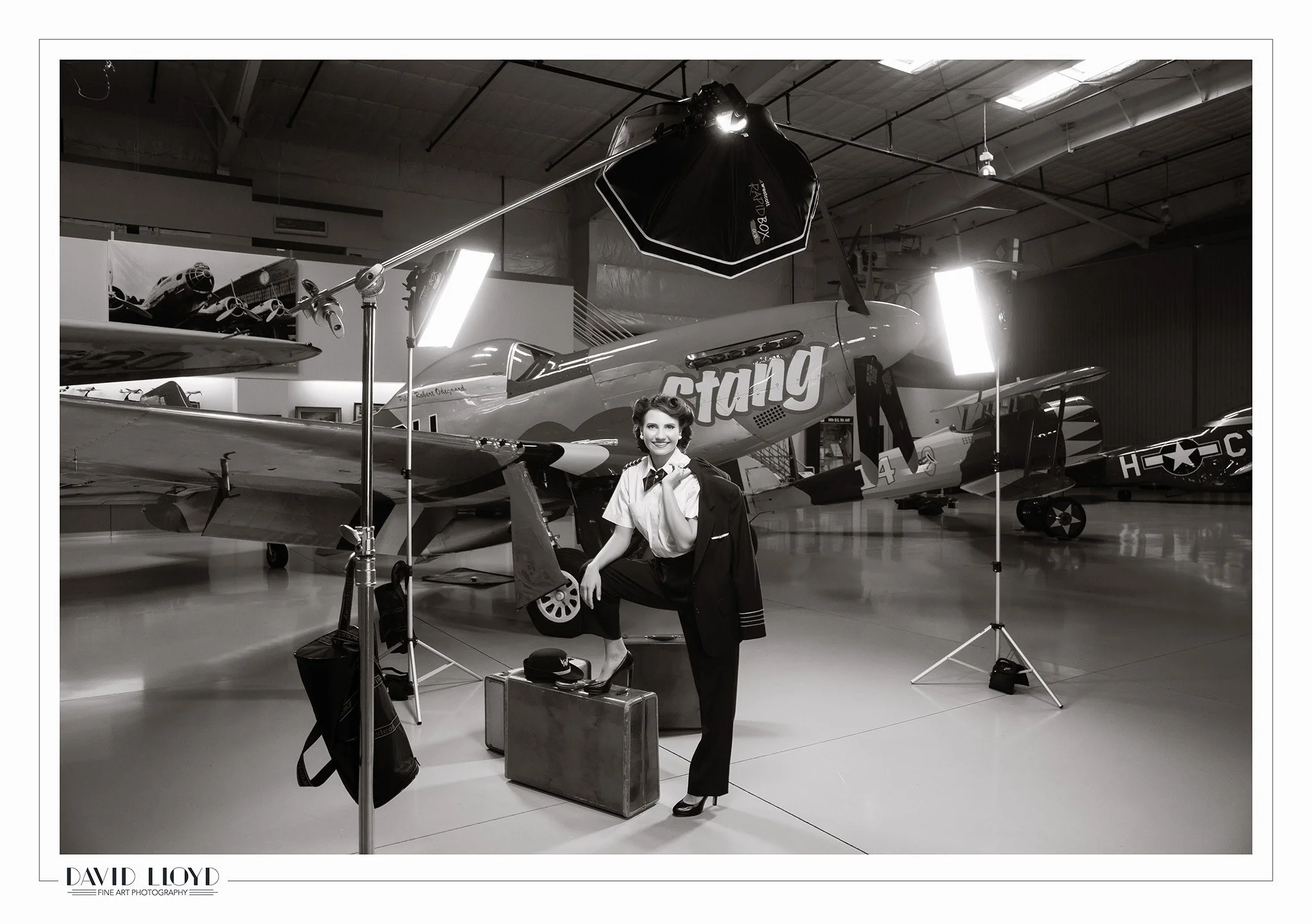
Script
This photograph was created decades later at the CAF Air Museum. The goal was not to imitate an old photograph literally. The goal was to recreate the underlying visual logic.
Directional light, Controlled fill, Separation, Shape, Character, The subject is modern, The equipment is modern, But the photographic problem is very old.
LIGHTING DIAGRAM: TRANSLATING HOLLYWOOD INTO AN ENVIRONMENTAL PORTRAIT
Script
Here is the Setup.
The boom Octabox becomes the principal modeling source. The umbrella provides fill. The two strip boxes provide rim and separation.
The equipment is radically different from the Fresnels of the 1930s and 1940s. But look at the functions; Key, Fill, Separation, Camera position. Those functions have not changed.
That gives us another principle:
The equipment changes. The jobs performed by the lights do not.
[SLIDE 11 — MY STUDIO: THE SAME IDEAS, MODERN TOOLS]
Script
This is another example from my own studio. On the left, we see the actual arrangement of modern lighting equipment. On the right, the resulting portrait.
And this is why I prefer to teach lighting by function.
The key light has a job. The fill light has a job. The hair light has a job. The background light has a job. Once you understand what each light is supposed to accomplish, the brand name becomes secondary.
Light is the language. Equipment is simply the vocabulary available to speak it.
TODAY’S MODIFIERS FOR YESTERDAY’S LIGHT
Script
Today we have extraordinary tools for recreating optical characteristics that once required large, hot studio lamps. A Fresnel attachment can concentrate and feather a beam.
A reflector can create a crisp directional source. A small octabox can become controlled fill or separation. A grid can restrict spill. A modern adapter can allow one system to use the modifiers of another.
The equipment is smaller, Cooler, More flexible. But the same question remains:
What kind of light do I want to create?
[SLIDE 13 — CREATIVE OCF LIGHTING TECHNIQUES]
Use Image #6, your book cover.
Script
These ideas eventually became part of the way I taught lighting.
In Creative OCF Lighting Techniques, I tried to break complex lighting down into relationships.
Direction.
Distance.
Exposure.
Ratio.
Function.
Because if we understand those relationships, we can recreate a lighting idea with almost any equipment.
[SLIDE 14 — LIGHTING AS A SYSTEM]
Use Image #7, the sample book pages showing the aircraft session and diagrams.
Script
These diagrams are not intended to tell a photographer:
“Put the light exactly seven and a half feet away.”
They are meant to make the relationships visible.
Main light.
Fill light.
Hair light.
Distance.
Angle.
Exposure.
Once those relationships are understood, the photographer can adapt them to almost any environment.
[SLIDE 15 — EXPOSURE IS PART OF LIGHTING DESIGN]
Use Image #8, especially the pages discussing exposure value.
Script
And this brings us directly back to Amos Carr in 1953.
Lighting and exposure cannot really be separated.
The meter does not make the photograph.
The photographer decides where the important tones will live.
Carr had a white shirt.
Skin.
Dark hair.
A black tie.
And yet the negative retained usable information across all of them.
Today, the digital sensor has replaced the negative.
But the underlying question is exactly the same:
Where do I want these tones to live?
[SLIDE 16 — THE CHARACTERS OF LIGHT]
This should be the concluding conceptual slide for Segment 1.
Possible visual categories:
MYSTERY — Greta Garbo
STRENGTH — Clark Gable
SCULPTURE — Hedy Lamarr
CHARACTER — Amos Carr portrait
CONTROL — Contemporary recreation
Script
We began with Hollywood inventing the face.
But what Hollywood really taught us was something larger.
Light has character.
It can reveal.
It can conceal.
It can flatter.
It can harden.
It can soften.
It can create authority.
Vulnerability.
Romance.
Danger.
Mystery.
And that leads to the conclusion of Segment 1:
Light does more than illuminate.
Light interprets.
[TRANSITION TO SEGMENT 2]
Script
Hollywood learned how to sculpt the face.
Paris was about to teach us how to sculpt the entire silhouette.
That takes us to Segment 2:
Paris, Haute Couture, and the Reinvention of Fashion.
For the blog, finish with a prominent link:
Continue to Segment 2 — Paris, Haute Couture and the Reinvention of Fashion
This version now has a very clear flow: Hollywood thesis → star construction → studio craft → Hurrell → Hedy → forensic reconstruction → Carr → exposure and ratio → your contemporary recreations → your teaching → the enduring character of light.