
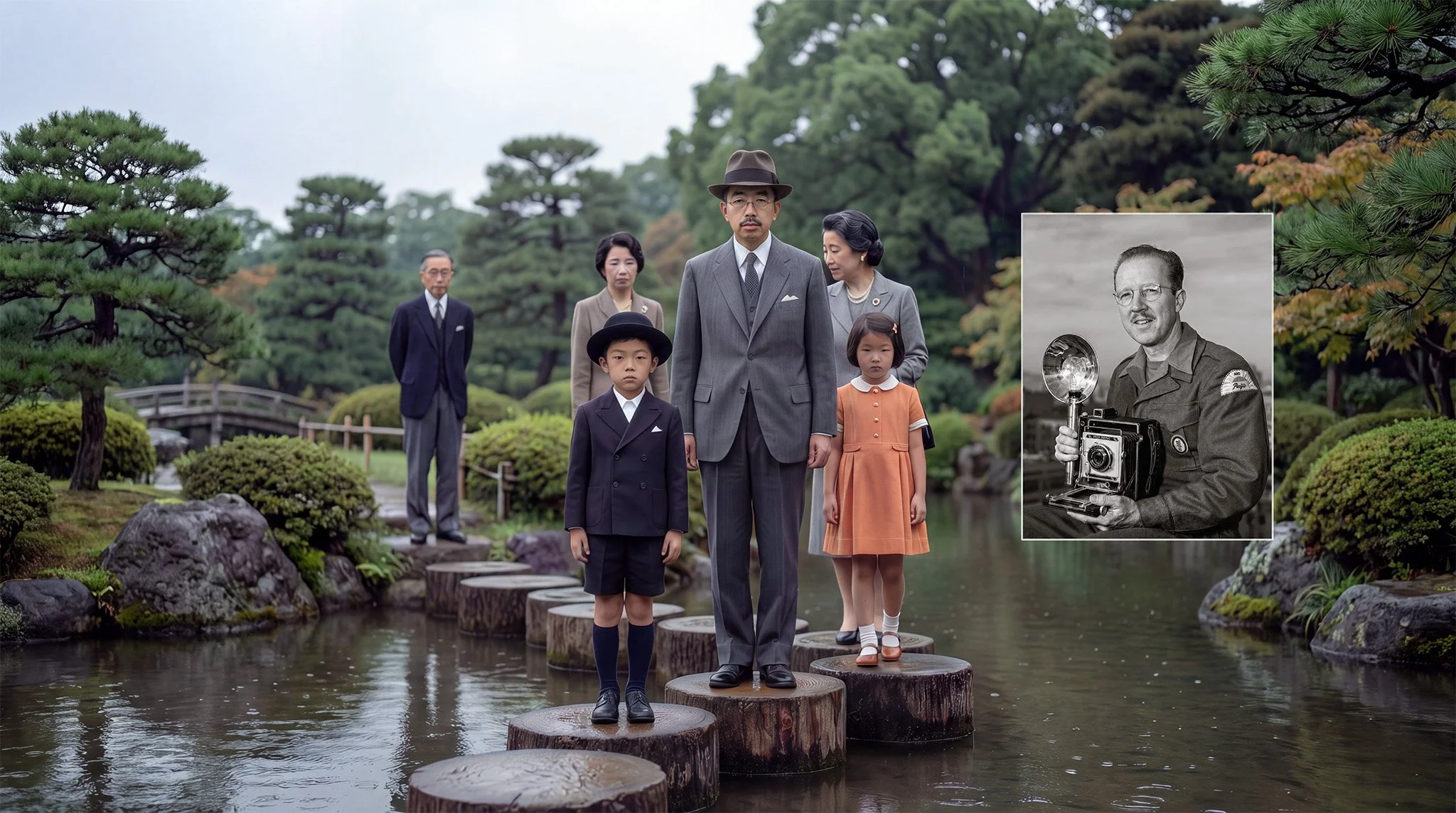
THE CORPORAL AND THE EMPEROR
An American soldier. A chance encounter in the ruins of Tokyo. And an extraordinary proposal that may have helped change the course of Japanese history.
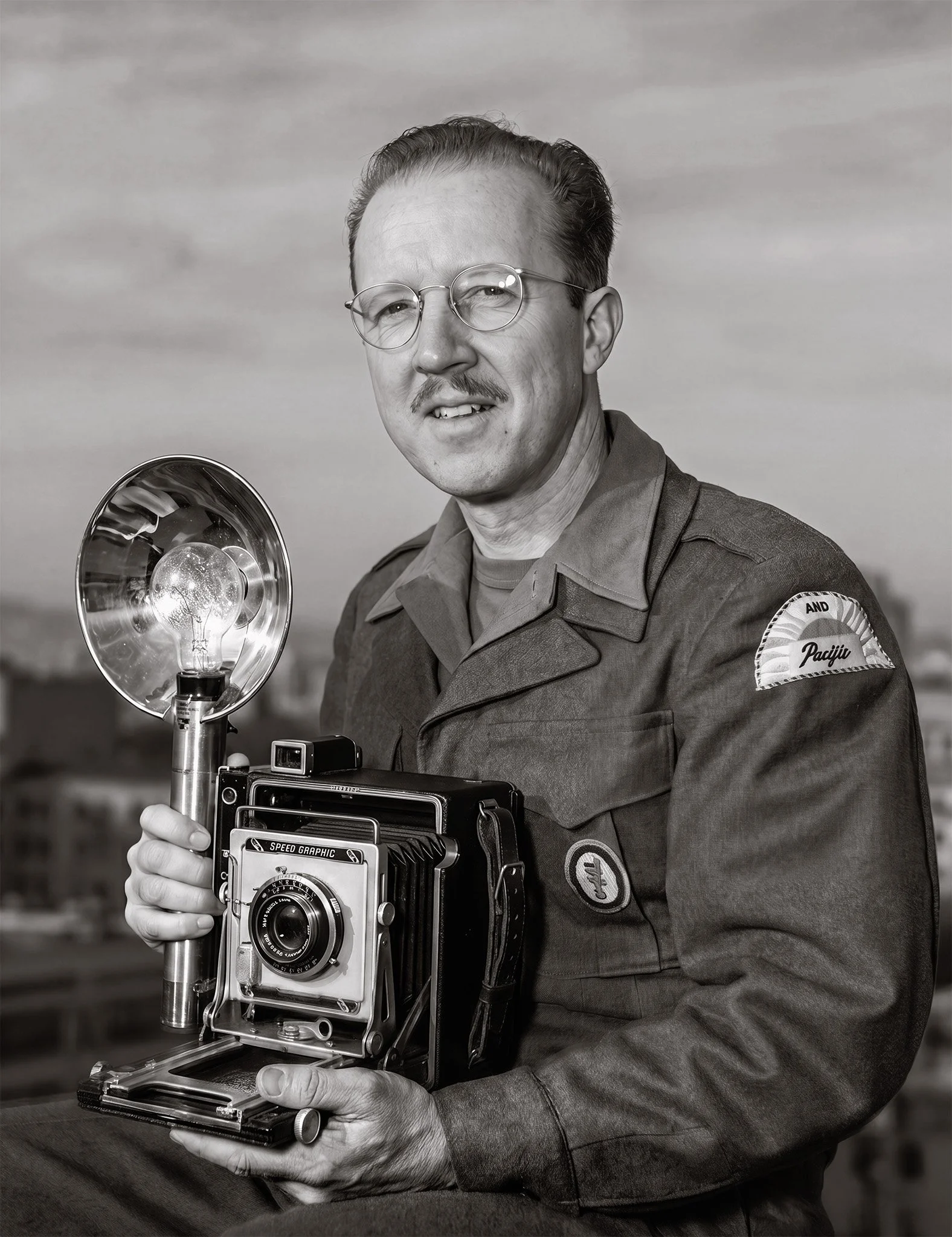
The remarkable story of Julian B. Ely, photographer and photo editor of Pacific Stars & Stripes 1945 - 1946
Introduced by his nephew, David Lloyd
An Extraordinary Story, Preserved in My Uncle's Own Voice
By David Lloyd
Julian B. Ely photographed with his Speed Graphic 4x5 camera, through which history would be told.
The Time & Place
Tokyo, December 6, 1945.
Japan has surrendered. Its cities lie in ruins. Emperor Hirohito, once revered by millions as a divine sovereign, faces an uncertain future. Some Allied leaders want him tried for war crimes. General Douglas MacArthur fears that removing him could plunge the defeated nation into chaos.
And on this particular morning, an American enlisted man is about to enter a meeting that he has no official authority to attend. He is neither a diplomat nor a political adviser. He carries no authorization from MacArthur's headquarters. In fact, his contact with Japanese government officials may constitute a serious violation of military orders.
He is a story teller and a photographer.
And he believes he has discovered a way to help resolve one of the most delicate problems facing the Allied occupation. That young American soldier was my uncle, Julian B. Ely.
Thirty four years later, in 1980, my Uncle Julian visited me and my family, my wife, Miyoko and our three daughters; Cindy, Olivia and Katherine, at our home in North Hollywood, California. I had heard portions of his remarkable experiences before, but I wanted to preserve the story as he remembered it. I asked whether I could record his recollections of how he had come to know Emperor Hirohito.
My Uncle Julian agreed…
As the cassette recorder captured our conversation, Julian transported us back to the closing months of World War II and the extraordinary circumstances that had carried him from an obscure Army assignment into the very heart of Japan's imperial establishment.
What fascinated me was not simply the importance of the people he had encountered.
It was my Uncle Julian himself.
His imagination. His humor. His extraordinary initiative. His ability to recognize an opportunity where others might see only an obstacle.
Above all, there was his unmistakable excitement at having lived through events that would become part of history.
Ten years after our conversation, Julian's account appeared in the November 1995 issue of World War II magazine, written with Allen Deever. The editors acknowledged the remarkable nature of his claims and reported receiving supporting affidavits, photographs, and documents. Now, more than eighty years after the events themselves, I have restored Julian's photographs and transferred my original cassette recording into digital format.
I invite you to follow his journey—not simply as a reader examining history from a distance, but as a companion to a young Army photographer who found himself unexpectedly caught up in an unforgettable unfolding post WWII drama.
Listen to Julian B. Ely tell his story — recorded by David Lloyd in North Hollywood, CA circa 1980.
[Original audio recording]
December 6, 1945 — A Meeting I Had No Business Attending
Julian's remarkable story in his own words
I was about to meet one of the most influential officials in the Japanese imperial government. Viscount Matsudaira, head of the Imperial Household Ministry, had agreed to receive me. I was an enlisted man in the United States Army, serving as photo editor of Pacific Stars & Stripes. I held no diplomatic credentials, and I had received no authorization to negotiate with the Japanese government.
In fact, General MacArthur's occupation headquarters had expressly forbidden independent contacts of this kind. I understood what that meant. If the Army discovered that I had arranged a private meeting with a senior Japanese official, I could face court-martial and the destruction of everything I had accomplished.
Yet I was not frightened away. I was exhilarated. I believed I had a solution to an extraordinary dilemma confronting Japan and the Allied occupation.
Emperor Hirohito stood at the center of it.
Eleven Allied nations had demanded accountability for Japan's wartime conduct. There were powerful voices calling for the emperor himself to face trial. MacArthur understood the danger. Without Hirohito, who could hold the Japanese nation together while we attempted to rebuild it? How could the emperor remain in place without appearing to escape responsibility?
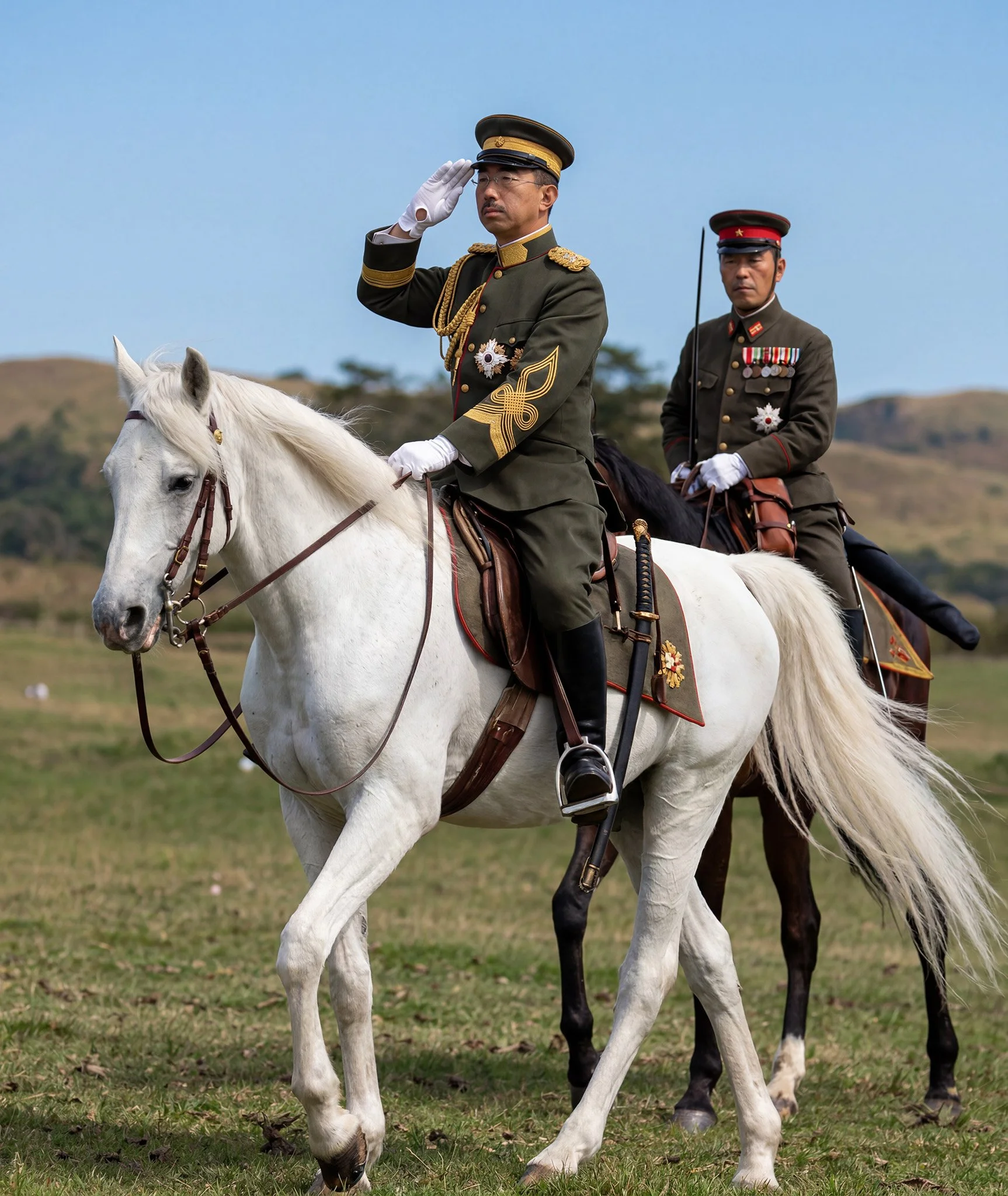
The Emperor Hirohito Standing Tall on His White Steed
June 10, 1940 the cover of Life Magazine
“I believed there was another possibility. And I had come to explain it.”
But to understand how an American photographer found himself sitting before the head of the Imperial Household Ministry, I must go back several months—to a miserable Army assignment in the Philippines, a letter I wrote home, and an unexpected encounter with a military censor.
Before the Emperor — The Engineer Who Became a Soldier
Julian B. Ely, standing at the left wearing glasses, during a motion-picture production at Lockheed before his voluntary induction into the U.S. Army. The scene reveals the elaborate lighting, camera equipment, and production crew involved in his early filmmaking experience. Photograph from the family collection, restored by David Lloyd. Date and production title not yet established.
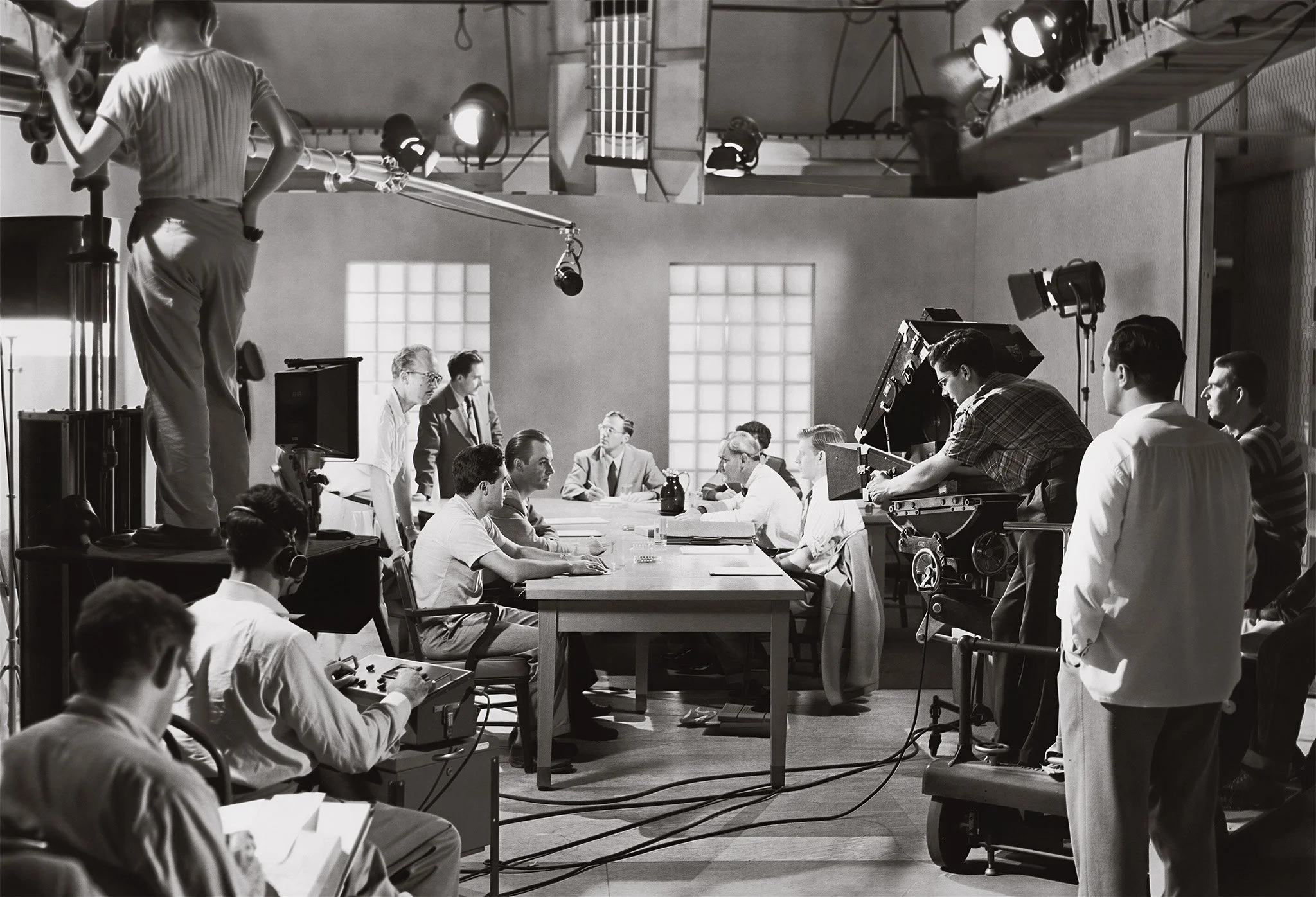
The induction, Camp Roberts training, infantry assignment, and transfer to the amphibious engineers come directly from Julian's recorded recollections, beginning at approximately 00:00. His engineering and filmmaking role at Lockheed is based on your family knowledge and the photograph, rather than a detailed job description in that portion of the recording.
One passage from Julian's interview is particularly revealing. At approximately 1:57, he humorously speculates that the Army transferred him into the amphibious engineers simply because his personnel records identified him as a production engineer. It is a delightful example of Julian's personality, and I have preserved that humor.
I would connect this chapter to the existing episode in which Julian first walks into the Pacific Stars & Stripes offices. The reader will then understand that he wasn't simply an inexperienced soldier who happened to acquire a camera. He brought with him a combination of technical experience, visual imagination, and personal initiative that would soon place him at the center of an extraordinary photographic adventure.
Julian's incredible story
Before I ever set foot in Japan, before I became a photographer for Pacific Stars & Stripes, I worked at Lockheed. Those were remarkable days in American aviation. Aircraft production demanded ingenuity, precision, and an understanding of how complicated machines and the people building them worked together.
My work combined engineering with another interest that had captured my imagination: filmmaking.
There was something fascinating about motion pictures. A camera could transform an ordinary scene into something compelling. The placement of a light, the movement of the camera, the arrangement of people within a composition—all could change how an audience understood what it was seeing.
Engineering taught me to solve problems. Filmmaking taught me to communicate ideas visually. I didn't realize it then, but those two disciplines would eventually prove invaluable in Japan. At Lockheed, I was accustomed to an environment where technical ability and creative thinking had practical value. A problem presented itself, and you worked out how to solve it.
Then I made a decision that would change everything.
I left Lockheed and volunteered for induction into the United States Army.
I trained at Camp Roberts, California, and entered the infantry as a buck private. The transition was something of a shock. In the Army, individual imagination was not always regarded as an asset. Orders were orders. Discipline was everything. And a private who preferred thinking for himself could find military life extraordinarily frustrating. I had gone from working in engineering and filmmaking to learning how to carry a rifle and follow instructions.
I was miserable.
I later told my nephew David, with considerable amusement at the memory, that I had never been particularly well suited to life as an infantryman. I had volunteered to serve my country. But I soon discovered that volunteering did not necessarily mean finding myself in circumstances where I could contribute my best abilities.
Then, quite unexpectedly, the Army provided my first escape.
A Production Engineer Becomes an Amphibious Engineer
When I arrived in the Philippines, I was part of a company of approximately 574 men.
The Army needed two men to transfer into the amphibious engineers, where they would train to operate landing craft. I was one of those selected. I never knew precisely why. But I had a theory.
My military records identified my civilian work as production engineering. Somewhere along the way, I suspected, someone had seen the word engineer and decided that an aircraft production engineer ought to make a suitable amphibious engineer.
Well, why not? I was delighted to get out of the infantry. Of course, the new assignment had its own rather alarming possibilities. Our training involved operating landing craft that would carry troops ashore during the anticipated invasion of Japan.
The prospect of delivering soldiers onto a hostile beach under enemy fire was hardly reassuring. Nevertheless, I had found myself in a different branch of the Army, and that alone seemed a considerable improvement.
By August 1945, I was training at Batangas in the Philippines.
The invasion of Japan was still an ominous possibility. And I was increasingly desperate to find some outlet for my imagination.
The Letter That Opened an Unexpected Door
I began writing letters home. Not ordinary letters filled with brief descriptions of Army life, but long, expressive accounts of what I was seeing and experiencing. Writing became a means of surviving the monotony.
I wrote about the absurdities of military life, my observations of the people around me, and the frustration of being a creative individual in an institution that seemed determined to eliminate every trace of individuality.
One particular letter was especially candid.
Shortly after writing it, I was summoned before a military officer. Now, in the Army, being summoned before an officer generally meant that something had gone wrong. I could think of several things in my letter that might have offended somebody. Perhaps I had gone too far. Perhaps I was about to find myself in serious trouble.
The officer was responsible for censoring outgoing correspondence. He looked at me and asked whether I had written the letter. I admitted that I had. Then something completely unexpected happened. Instead of reprimanding me, he praised my writing. He wanted to know whether I had ever written professionally. I told him that my experience was limited to helping with the yearbook in high school.
To my utter surprise, he suggested that I might be just the person to write for the battalion newspaper. I could hardly believe my good fortune. After months of frustration, someone had recognized an ability that had absolutely nothing to do with carrying a rifle or operating a landing craft. And suddenly, a different future seemed possible.
The officer began arranging my transfer. I was elated. Then, before the arrangements could be completed, the atomic bombs were dropped on Japan and the war ended.
Everything changed. The invasion for which we had been preparing would no longer take place.
Japan had surrendered.
Our unit received orders to proceed to the home islands as part of the occupation force. My newspaper assignment disappeared. But something far more extraordinary was about to take its place. I had no way of knowing that the combination of engineering, filmmaking, and a passion for photography would soon bring me into the presence of Emperor Hirohito himself.
Nor could I have imagined that a casual Sunday walk through the ruins of Tokyo would eventually lead to a meeting with one of the highest officials in Japan's imperial government.
I was about to discover that history sometimes opens its doors to those who are curious enough to knock.
A Borrowed Camera and I, Photographed an Emperor
It was during one of those trips that I walked into the offices of Pacific Stars & Stripes.
I knew no one. But I introduced myself to Corporal Leon Ray, the chief photographer, and asked whether I might accompany him on an assignment. He agreed and of course, I was thoroughly delighted. Here was the life I had imagined: a camera, a newspaper, and an opportunity to record events that the entire world wanted to understand.
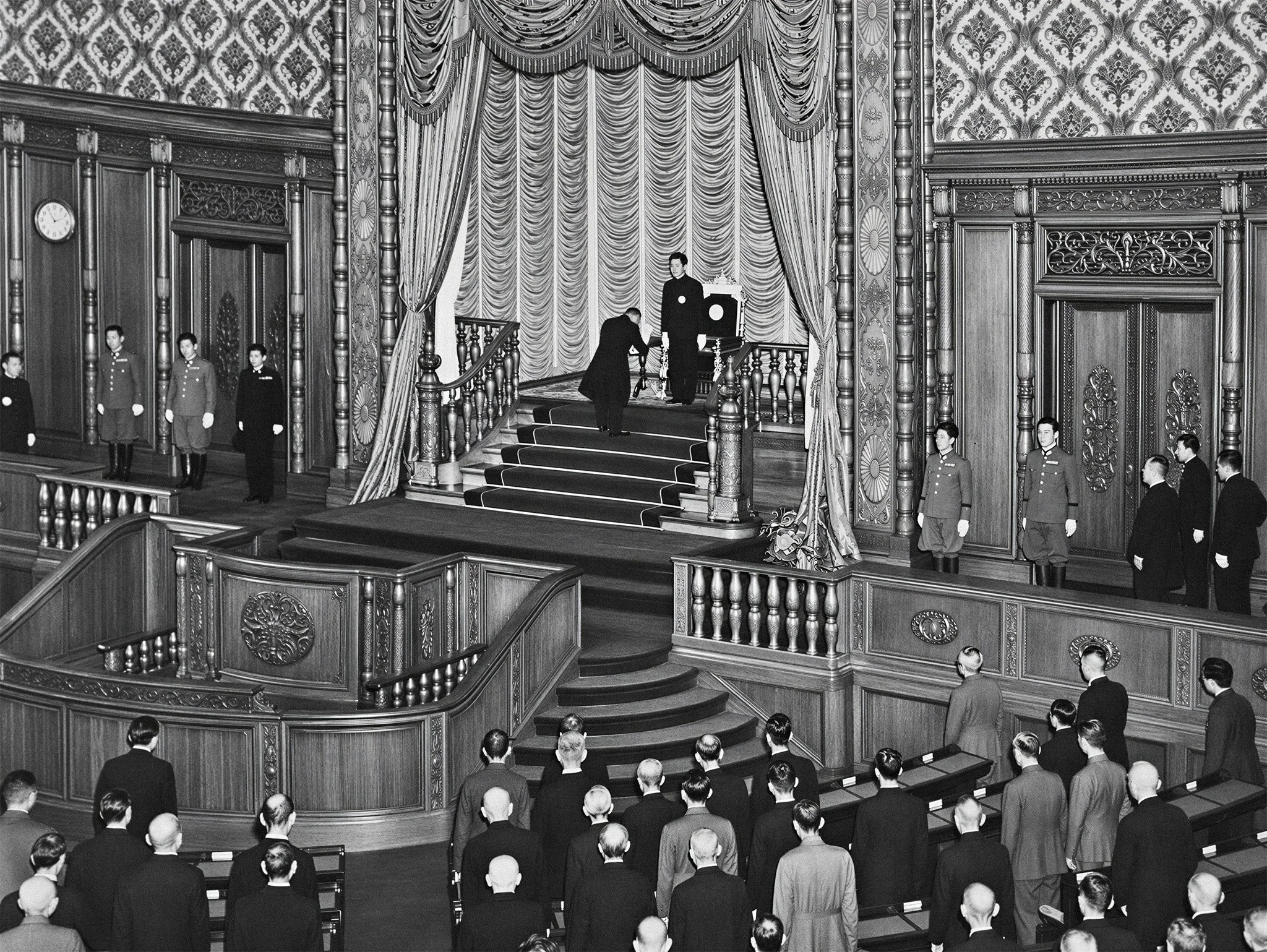
On a subsequent visit, Ray lent me an old 4×5 Speed Graphic. The camera was battered, and its shutter had a troublesome habit of sticking. But it was a professional press camera, and it was in my hands. One of my earliest assignments took us to the Japanese Diet, where Emperor Hirohito was to participate in the first reopening of a postwar parliamentary session.
The world's press was gathered there.
I found myself in the extraordinary position of photographing the man whose fate had become one of the central questions of the occupation. I wanted something more than the conventional photographs being taken by the other correspondents.
While we waited for the emperor to arrive, I left my position and went downstairs to investigate his entrance. There, I discovered the doorway reserved for his arrival.
The Japanese attendants were not pleased to find an American photographer positioning himself along the emperor's route. I was courteous, but persistent. I arranged spare flashbulbs on nearby steps so that I could reload quickly, and waited.
Then Hirohito arrived. I began photographing. There was no time for elaborate preparation. The emperor was moving, the ceremony was beginning, and every second mattered. I captured several exposures before returning to the gallery. By then, the other photographers had occupied the available positions in the balcony.
I could scarcely see over their heads. So I placed my camera case behind them, climbed onto it, and raised the Speed Graphic above my head. I could no longer look through the viewfinder from that position. I had to judge the framing purely by instinct.
The emperor stood to deliver the imperial rescript.
I raised my camera, aimed as best I could, and fired a single powerful #3 flashbulb. That was my opportunity. Back at the newspaper, I discovered that Leon Ray had missed the shot. Mine had succeeded. The picture appeared on the front page of Stars & Stripes—although, as I later recalled with some amusement, the credit went to Ray.
It hardly mattered though, as I had demonstrated that I could do the work and get the shots. Before long, I received the transfer orders that would change my life. I was now part of the newspaper staff. I sincerely felt that I was where I belonged. What unfolded was beyond what I could have imagined.
“This is history. This is the biggest history you could ever live through.”
— Julian Ely, recorded in 1980, approximately 8:03
October 28, 1945 — Two Strangers on the Ginza
It was a Sunday afternoon, and I had gone walking through Tokyo with my Leica 35mm camera. The Ginza had once been one of the most fashionable shopping districts in Japan. Now, much of it was nothing more than shattered buildings and piles of rubble. I wandered through the ruins, looking for photographs. To my wonder and surprise, one of the first small building under construction was a beauty parlor.
After a while, I noticed something unusual. Two Japanese gentlemen appeared to be following me. Whenever I looked back, they smiled and bowed. At first, I just continued walking. They continued following. I was alone, an American soldier in a recently conquered country, and I was not entirely comfortable being approached by strangers. But there was something disarming about their manner. They seemed genuinely delighted to see me. Eventually, I slowed and allowed them to catch up.
To my surprises, they introduced themselves in excellent English. One was Professor Ryu, a university teacher. The other was Coosaku Fujitsuka, an architect and expert in judo. They were looking to meet an American soldier with whom they could become acquainted. And I, as it happened, was curious to learn how the Japanese people viewed the occupation. Our conversation began almost casually. But before it ended, something happened that profoundly affected me.
Professor Ryu apologized because he could not invite me into his home. And through our conservation, I soon learned why. His home had been destroyed by American bombing. I was utterly astonished. Here was a man who had lost his house and possessions in the war, apologizing to an American soldier because he could not extend the hospitality he felt was appropriate. I asked him how he could possibly feel that way. His answer stopped me cold.
He explained that war was inhuman. If he blamed me personally for the destruction of his home, then I might just as easily hold him responsible for the terrible atrocities committed against Americans during the Pacific War. What, he asked in effect, would such mutual hatred accomplish? His reasoning was extraordinary. Standing amid the ruins of Tokyo, I was being offered a lesson in humanity by a man whose country we had just defeated.
He did not see me simply as a representative of the occupying army. He saw me as another human being. I left that encounter with an entirely different understanding of the Japanese people. And I made a personal resolution. During whatever time remained of my assignment in Japan, I would try to do something constructive to help heal the wounds of war. I could not then have imagined what that resolution would lead to.
“They were just looking for a GI to make friends with.”
— Julian Ely, recorded in 1980, approximately 17:43
An Idea That Would Not Leave Me Alone
Japan had been defeated militarily, but its future remained profoundly uncertain. I had seen the destruction firsthand. I had watched civilians struggling amid the ruins, without homes, adequate food, or any clear sense of what tomorrow might bring.
And I kept returning to one question. What could give these people hope? The answer, I believed, lay with the emperor. Hirohito was the one figure around whom the Japanese people had organized their national identity. Yet he remained remote from ordinary life, separated from his people by centuries of imperial tradition and the belief in his sacred status. If he continued to occupy that distant position, how could he lead his nation into a new era?
But if he were removed altogether, who could replace him? I began to see another possibility. What if Hirohito were to become a genuinely human figure in the eyes of his people? What if he were seen not as an inaccessible deity, but as a husband and father who shared their grief and their hopes? What if he traveled throughout Japan, met ordinary citizens, and encouraged them to rebuild their cities and their lives?
I was a war correspondent photographer, working for the Pacific Stars and Stripes Newspaper. I might have an angle. Naturally, I began imagining the transformation in in the form of pictures. A photo essay, describing the Emperor as a flesh and blood human being. I envisioned an informal photographic story showing the emperor and his family in their gardens, at leisure, doing the ordinary things that families do.
The images themselves could communicate a powerful message. This was not simply a matter of obtaining an exclusive photograph. I believed such pictures could help the Japanese people see their emperor differently—and help Americans understand Japan differently as well. But photographs alone would not resolve the dilemma. Something more fundamental was required. Hirohito would have to renounce the divine status that separated him from the people he was meant to lead. Only then, I believed, could he become a powerful symbol of national renewal.
I wrote out my proposal in story format. At Lockheed, I had written film stories and had introduced the idea of a series of still images translated into a slide presentation.
However, I had no influence in government, no political connections, and no diplomatic experience. What I possessed was an idea—and two remarkable Japanese friends, who were eager to listen to me.
November 25, 1945 — The Door Opens
Four weeks after our first encounter on the Ginza, I met again with Professor Ryu and Fujitsuka. I explained my proposal. I described the emperor's predicament, MacArthur's dilemma, the devastation I had witnessed, and the opportunity I believed existed to transform Hirohito's public role. I expected them to regard my ideas as hopelessly unrealistic. Instead, to my amazement, they became enthusiastic. Then Fujitsuka said something that took me completely by surprise. He said he knew people with connections to the Imperial Household Ministry. Perhaps he could arrange for my proposal to reach someone important. I was astonished at his offer.
An architect I had met by chance on a devastated Tokyo street might be able to open a door into the emperor's own government. I entrusted the proposal to my Japanese friends, totally understanding the risk.
The occupation authorities had forbidden private contacts with Japanese government officials. If it became known that I was independently attempting to influence Japanese policy, I could find myself in very serious trouble. But I believed the opportunity justified the risk. On November 30, Fujitsuka returned with news. Viscount Matsudaira, head of the Imperial Household Ministry, had agreed to meet with me. The appointment was set for December 6, 1945.
Suddenly, the impossible was happening.
December 6, 1945 — Before Viscount Matsudaira
When the appointed day arrived, I went to meet Matsudaira. I was now photo editor of Stars & Stripes, with responsibilities that allowed me considerable freedom of movement and assignment. But I was still an American enlisted man. And I was about to explain to a senior imperial official how I believed his emperor could help save Japan. There was something almost absurd about the situation.
The Japanese government had every reason to assume that someone in my position would not have arranged such a meeting without official approval. Yet I had come entirely on my own initiative. Matsudaira received me respectfully. I explained what I had witnessed in Japan. The ruined cities. The widespread poverty. The confusion and uncertainty of a defeated people.
I told him that I believed Hirohito remained essential to Japan's future. But the emperor could not inspire his people while remaining beyond their reach. If Hirohito were to abandon his divine status and become a visibly compassionate, approachable leader, I argued, the Japanese nation might rally around him in the enormous task of reconstruction. I explained how photography could help communicate that transformation. I described the picture story I envisioned: the emperor as a family man, seen in ordinary surroundings, followed by public appearances throughout the country. Hirohito could become a symbol not of imperial conquest but of national recovery.
Matsudaira quietly listened with visible interest. I had come prepared to defend what many would consider an outrageous proposal from an American soldier. Instead, I found myself speaking to a man who appeared to understand the problem as deeply as I did. When I finished, he thanked me for coming. He promised to bring the matter before the Japanese cabinet. I left knowing that my proposal had reached the highest levels of the imperial government. Now there was nothing to do but wait.
January 1, 1946 — The Emperor Speaks
On December 19, 1945, I learned that the Japanese government had accepted the recommendations presented through Matsudaira.
I could scarcely believe the potential implications, the audience and the acceptance of my idea.
And then, on New Year's Day, January 1, 1946, Emperor Hirohito issued the declaration that would become one of the defining statements of Japan's postwar transformation. In his rescript, he rejected the conception of the emperor's relationship with his people as resting upon divine mythology and racial superiority.
The emperor was presenting himself—and the relationship between the throne and the Japanese people—in dramatically altered terms.
For Japan, the implications were enormous. For me, the significance was deeply personal. Only two months earlier, I had been walking through the rubble of the Ginza when two strangers approached me. That chance encounter had led to friendships, conversations, a written proposal, and an extraordinary meeting with the head of the Imperial Household Ministry.
Now the emperor himself had issued a declaration addressing the very subject that had occupied my thoughts. I believed my proposal had helped bring about the change. I subsequently learned that others, in both Japanese and occupation circles, had been considering ways to redefine Hirohito's public position.
I could not claim that the idea belonged to me alone.
But the timing, the response to my proposal, and the events that followed convinced me that my intervention had mattered. I knew what I had proposed. I knew whom I had met with. And I knew what had happened afterward. The full question of who influenced the imperial declaration would be left for historians to debate.
Behind the Imperial Curtain
The story did not end with the New Year's declaration. My photographic proposal had opened another extraordinary opportunity. For months, photographers from around the world had sought informal pictures of Hirohito and his family.
Such photographs had scarcely been possible under the old imperial conventions. I had imagined a picture story that would reveal the emperor's humanity. Now I was being invited to help make such photographs. The Imperial Household Ministry arranged a special visit to the emperor's summer residence at Hayama.
I took my friend Charlie Gore, an Associated Press photographer, with me. Charlie was an excellent photographer, and I valued having someone I trusted at my side during an assignment of such importance.
We arrived with our cameras and film, knowing that we would have an extraordinary opportunity to photograph the imperial family outside the ceremonial world in which the public usually saw them.
And there they were. Emperor Hirohito. Empress Nagako. Their children. Not simply remote figures in an imperial procession, but a family spending time together near the sea. We photographed them strolling through the grounds, enjoying the gardens and walking along the shore.
At one moment, a wave rushed unexpectedly toward the family. Several of them were caught by the water, which elicited spontaneous laughter.
Charlie captured the scene. I missed it because I was reloading film in my camera.
I never forgot that moment. Photography is often a matter of being ready for the one instant that cannot be repeated. Later, while walking ahead of the group, I glanced backward and noticed a particularly beautiful arrangement of trees and shadows.
I hurried into position. Dropping to one knee, I raised my camera and made the exposure. The composition came together almost instinctively.
I knew I had something special.
“It was as spontaneous as anything you can imagine.”
— Julian Ely, recorded in 1980, approximately 31:23
One photograph from the visit eventually became a treasured possession, bearing the autographs of the emperor and empress. There is, however, a small story behind that print. The emperor had actually signed a different photograph, one I did not particularly like. I later arranged for the signatures to be incorporated into the photograph I preferred which took a prominent place in my home years later.
The photograph itself remained one of my proudest achievements. There was another moment at Hayama that I valued even more.
The emperor spoke to me in English. His protocol officers appeared astonished. For a figure traditionally surrounded by elaborate conventions of rank and ceremony, such an informal conversation with an American enlisted photographer was extraordinary. Yet there we were, talking and sharing a moment of genuine human contact. The very transformation I had imagined was becoming visible before my very eyes and being historically recorded by my camera.
A Window Lowered for One Photographer
In the months that followed, I accompanied or photographed the emperor on several of his public appearances. Hirohito was beginning to visit different parts of Japan, allowing ordinary citizens to see him in ways that had previously been almost unimaginable. The worldwide press followed these events closely. On one occasion, I was photographing the emperor aboard his private railway car. Photographing through a window is always troublesome. Reflections and imperfect glass can spoil an otherwise valuable image. Hirohito noticed me among the photographers. The window was lowered. I made my photographs without the glass interfering. Then the emperor continued his journey. It was a small courtesy.
But to me, it spoke volumes about the extraordinary circumstances in which I found myself. I had entered Japan as an obscure soldier with an uncertain future. Now the emperor was extending personal consideration to me as I recorded his public appearances. The distance between my old life and this new one seemed almost impossible to comprehend.
The Life I Might Have Lived
As my assignment in Japan approached its end, opportunities appeared that could have changed the direction of my entire life. Fujitsuka, whose friendship had begun with that first meeting on the Ginza, wanted me to remain in Japan. He offered to provide a home for me in Tokyo if I would settle there. Prince Katsura, a relative of the emperor, proposed that I become photographic editor of a new Japanese picture magazine modeled after Life. It was a remarkable offer. I could have continued working in Japan, photographing the enormous changes taking place throughout the country. I might have built an entirely different career.
But I had made a promise to myself. I wanted to return to the United States and attend college. I believed that if I settled down and started a family before completing my education, I might never have the opportunity. So I went home.
I left Japan carrying extraordinary memories, photographs of historical importance, and friendships that had transformed my understanding of the world. I had been a participant in events I could never have imagined when I entered the Army.
And it had all begun with a letter written during a miserable period of military service—and a chance encounter between three strangers on the Ginza.
“It was all just one thing following another.”
— Julian Ely, recorded in 1980, approximately 24:46
Epilogue — Thirty Four Years Later
David Lloyd
As Julian finished recounting his extraordinary experiences in our North Hollywood home in 1980, I had no way of knowing how important that cassette recording would eventually become. I was preserving a family conversation.
Today, I realize that I was also preserving a firsthand historical account. When I listen to Julian's voice, what strikes me most is the remarkable excitement with which he recalled those days. He understood that the events unfolding around him were momentous. And instead of standing aside, he found ways to participate.
He was not a general, a statesman, or a diplomat.
He was a creative young man with a camera, a willingness to meet strangers, and the audacity to act upon an idea. Whether his proposal was the decisive influence behind Hirohito's New Year's declaration remains a question for historical investigation. But the events Julian described, his photographs, his published account, and his recorded recollections leave us with an extraordinary story worthy of being examined and preserved.
I find myself returning to that October afternoon in 1945. Had Julian taken another street, had he ignored the two Japanese gentlemen following him, or had he simply been too preoccupied to stop and speak with them, how differently might his life have unfolded? There is something deeply moving about that thought.
History is often presented as the work of governments, armies, and powerful leaders. Yet sometimes, in its most unexpected moments, it is shaped by the curiosity, imagination, and courage of ordinary individuals.
My uncle Julian believed that he had experienced just such a moment. And in 1985, he entrusted his story to a recording that allows us to hear him tell it, in his own words, today.
This is the beginning of my journey to preserve and share his remarkable life in photography and the extraordinary history he witnessed.
The story continues.
Historical and archival notes
This narrative is a first-person literary adaptation based on Julian B. Ely's account, written with Allen Deever and published in World War II magazine, November 1995, pages 47–52, together with Julian's recorded recollections from 1980. It is not presented as a verbatim transcript. Dialogue and internal reflections outside the labeled audio quotations are reconstructed from Julian's accounts.
Julian's 1980 audio confirms that he carried a small 35mm camera on the Ginza; its identification as a Leica comes from David Lloyd's personal recollection of what his uncle told him.
The role Julian attributed to his proposal in Hirohito's January 1, 1946 declaration remains a historical claim requiring further independent verification.
The selected audio quotations and timestamps are based on an automated transcript and should be checked against the original recording before publication.