
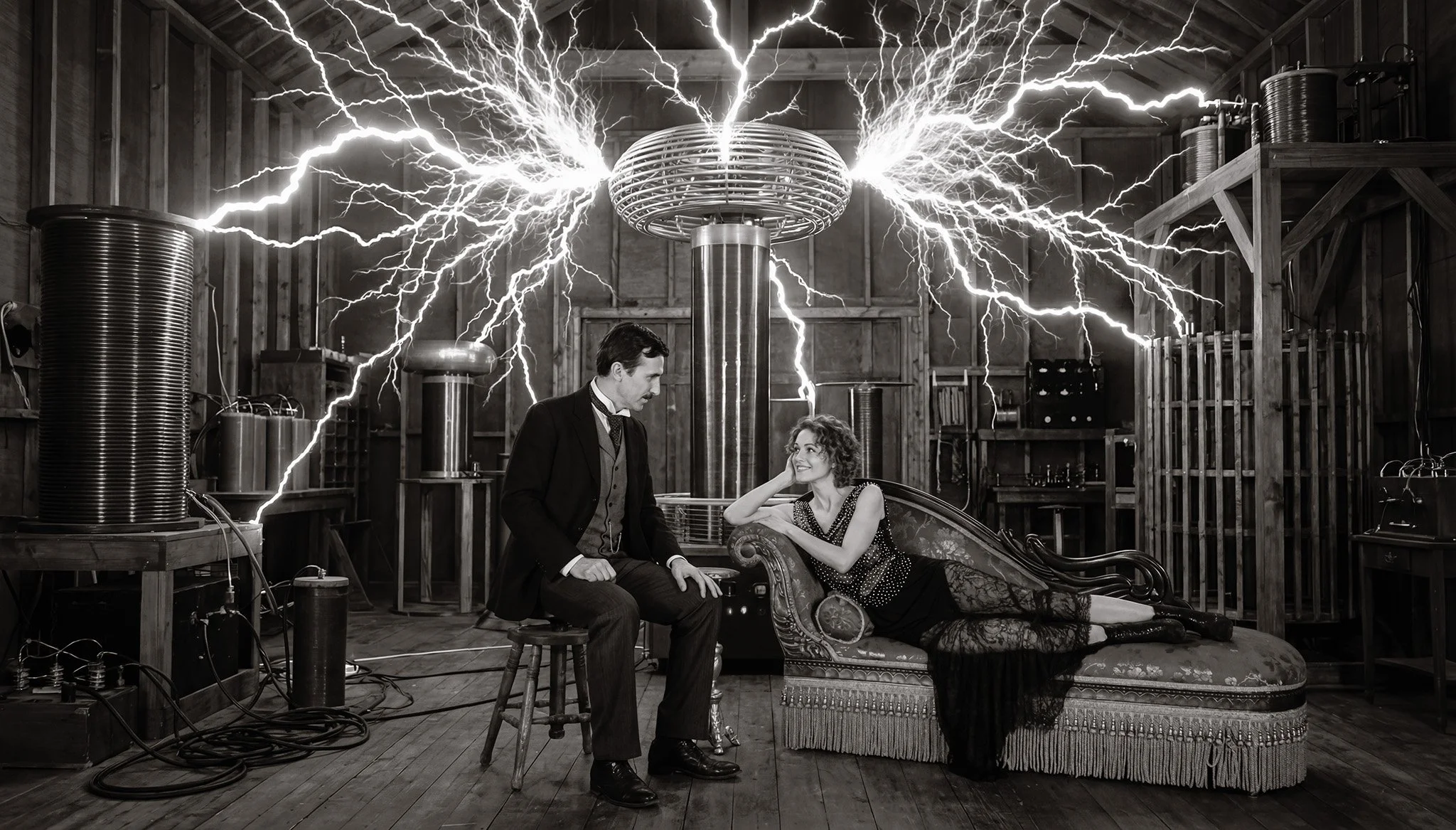
Tesla & Bernhardt, Secretly Meet
History keeps its ledgers neat—dates, patents, premieres, applause measured in curtain calls and kilowatts. But between those lines, there are nights no archive records. This is one of them.
In the thin, electric air of Colorado Springs, where storms climb the mountains like living things, Nikola Tesla built a cathedral of wire and intention. His laboratory stood apart from the town’s lamplit streets, a place where lightning was invited indoors and obeyed. Copper coils rose like musical staves. Sparks leapt, sang, and vanished. Tesla called it research. Others called it sorcery.
And then, one evening, a carriage arrived unannounced.
Wrapped in velvet and rumor, Sarah Bernhardt—the Divine Sarah—stepped into the high plains wind. She was accustomed to entrances that bent rooms around her. Parisian salons, London stages, New York theaters—each had felt her gravity. Yet here, in the American West, she came not for applause, but for silence.
Tesla met her at the door…
The Unwritten Invitation
No letters survive that speak plainly of her journey west. There is only the possibility—an invitation folded into a pocket, a sentence written between sentences. Bernhardt had always been drawn to the edge where art brushes the unknown. Tesla lived there.
Inside the laboratory, the night began to hum.
Tesla adjusted a switch. The great coil awakened. Lightning unfurled across the room, branching in blue-white filigree, answering a rhythm only he seemed to hear. Bernhardt watched without fear. She had embodied queens and specters; electricity, she sensed, was another kind of theater.
“Light,” Tesla said softly, “is not merely seen. It remembers.”
Fireballs and Confessions
As the storm gathered beyond the windows, Tesla released one of his more secret demonstrations. From the coil’s crown bloomed spheres of fire—luminous globes that drifted, paused, and dissolved like thoughts set free. Fireballs, the newspapers would later whisper, though no journalist was present to witness them.
Sara Bernhardt stands in amazement as Nicola Tesla demonstrates the electrostatic fireball phenomena to her in his experimental Colorado laboratory.
Bernhardt reached out—not to touch, but to feel the warmth pass her hand.
“In Paris,” she said, “we chase immortality through roles. You chase it through forces.”
Tesla smiled, a rare, almost boyish curve. “Perhaps,” he replied, “we are chasing the same thing from opposite sides of the stage.”
What followed was not romance in the ordinary sense. No declarations. No promises. Instead, a courtship of ideas. She spoke of breath and timing, of the moment an audience leans forward together. He spoke of resonance, of frequencies that cause the world itself to lean in response.
While Sarah and Nicola discussed science and art, there grew a mutual fascination, a rare kind of affection between the two, the scientist and the artist, grew close. Though neither were to marry throughout their lifetime. Perhaps theirs was a kind of etherial love, transcending the physical.
Two disciplines, one truth: energy moves where attention goes.
The Storm Breaks
Outside, thunder cracked the sky open. Tesla threw the final switch.
Lightning roared through the laboratory, louder than cannon fire, brighter than any footlight Bernhardt had ever known. For a breathless instant, the room became pure illumination. In that white silence, art and science stood equal—no longer opposites, but mirrors.
When the light faded, Bernhardt was laughing, a sound as alive as the storm itself.
“You see,” she said, “even the heavens applaud.”
Morning Without Witnesses
By dawn, the laboratory was quiet again. The fireballs were gone. The coil slept. Bernhardt departed as discreetly as she had arrived, leaving no program, no signed photograph, no proof.
Only the air seemed changed—charged, as if it remembered what had passed through it.
Tesla would go on to refine his visions of wireless power, of energy shared freely across distance. Bernhardt would return to the stage, carrying with her a deeper fire, one that critics could never quite name.
History would keep them separate: the scientist alone with his machines, the actress adored by millions. Yet on one Colorado night, lightning had bridged the distance.
Some meetings do not leave records.
They leave resonance.
And if you stand on the plains when a storm rolls in—if the thunder feels oddly intimate—you might wonder whether the air is replaying an old conversation between light and voice, invention and art, Tesla and Bernhardt, still echoing, just beyond sight.
A Strange Transport of Thought Through Time
In the setting of Nicola Tesla’s Colorado Laboratory, where his generation of lighting and other experiments evolved, there mused a tall slender man centuries beyond his time. Pondering in the presence of his electrostatic field generation, his thoughts travel into the future. The future of what if’s?
Thought Across Time: Tesla, Verne, Hill, and the Physics of Imagination
There are moments in history when imagination appears to behave less like fantasy and more like a form of signal transmission. An idea arises in one mind, in one century, and later materializes—almost intact—in another. This phenomenon invites a question that lives at the intersection of science and mysticism:
Can thought project itself through time and space?
In the imagined scene of Nikola Tesla standing in his Colorado Springs laboratory—hand to chin, eyes fixed on a shimmering apparition of a future yet unborn—we glimpse a symbolic truth. Tesla was not merely inventing machines. He was tuning himself, like one of his resonant coils, to something beyond the immediate present.
Tesla and the Creative Field of his Expansive Mind
Tesla often spoke of ideas arriving fully formed, as if received rather than constructed. In modern terms, we might describe this as intuition or pattern recognition. But Tesla framed it differently: he believed the universe itself was alive with energy, frequency, and vibration—and that the human mind could resonate with it. From a scientific standpoint, thought is electrical. Neurons fire, synapses spark, and measurable electromagnetic fields radiate from the brain. From an esoteric standpoint, those same fields may be carriers of something subtler—intention, vision, archetype.
Tesla lived at the threshold where physics had not yet drawn its hard borders. A time when radio waves were also invisible myths, yet to be discovered.
Could Nicola Tesla, like Jules Vern, project his thoughts forward in time?
Jules Verne: The Engineer of Tomorrow’s Dreams
Long before submarines circled the globe or rockets pierced the atmosphere, Jules Verne wrote about them with startling technical accuracy. Verne did not predict the future by accident. He reasoned it into existence by extrapolating first principles—materials, energy, propulsion—and then allowing imagination to complete the circuit. What Verne demonstrated was this: imagination constrained by logic becomes prophecy. His work suggests that when imagination is disciplined by science, it becomes a prototype generator for civilization itself.
Napoleon Hill and the Master Mind Beyond Time
Decades later, Napoleon Hill articulated a radical idea in Think and Grow Rich: the Master Mind. Hill described it as a mental alliance where great thinkers—living or dead—could be “called upon” for counsel through focused intention. Whether one interprets this psychologically or metaphysically, the mechanism is compelling. By immersing the mind in the patterns, values, and methods of great innovators, one begins to think as they thought. Over time, the boundary between self-generated insight and inherited genius blurs. Hill did not require séances or superstition—only concentration, reverence, and repetition.
Elon Musk and First Principles as Time Travel
In the modern era, Elon Musk represents a living embodiment of this lineage. Musk’s well-documented use of first-principles thinking mirrors Tesla’s mental laboratories and Verne’s speculative engineering. By stripping problems down to their fundamental truths—mass, energy, cost, physics—Musk reconstructs solutions that appear futuristic only because most people never think from the bottom up. When Musk imagines reusable rockets, autonomous machines, or electric vehicles as inevitable rather than aspirational, he is not forecasting the future—he is inhabiting it mentally before it exists. In this sense, first-principles thinking becomes a form of cognitive time travel.
Thought Projection: Metaphor or Mechanism?
So is thought projection through time merely poetic language? Or is it an emergent property of how human cognition interacts with reality?
From science, we know:
• Information propagates through fields.
• Patterns repeat across scales.
• Ideas evolve like organisms, mutating and reappearing.
From mysticism, we suspect:
• Consciousness may not be entirely local.
• Intention shapes perception.
• The future leaves faint echoes backward.
Between these views lies a productive ambiguity—one that inventors, artists, and visionaries have always occupied.
The Silent Conversation Across Centuries
In imagining Tesla witnessing a holographic vision of a future innovator and his creations, we are not suggesting literal time travel. We are acknowledging something subtler: that great ideas form a continuous conversation, carried forward by minds capable of receiving them.
Niclola Tesla imagines, projects his thoughts and vision into invention.
Jules Verne imagines, looks into the future for possibilities, then write his novels.
Napoleon Hill focuses his intent by correspondance.
Elon Musk executes thought into reality.
Each plays a role in a relay race where the baton is not matter—but thought itself.
And perhaps the most provocative idea of all is this: If such a conversation exists, it is not limited to time or technology, for as it exists in the mind, the manifestation only requires the intersection of two like thoughts.
The laboratory of the mind is still humming.